For more than two decades, Turnitin has been the trusted tool for detecting plagiarism across academic institutions. Yet in 2026, students, universities, publishers, and even businesses are actively searching for Turnitin alternatives.
And what has led to this change? Turnitin was built for a time when plagiarism was rampant. Today, the greater challenge is AI-generated content.
While Turnitin launched its AI detector a few years ago, institutional-only access, weak AI detection, a lack of explanation for reports, and expensive pricing have led educators and organizations to reassess the need for Turnitin.
Tools like ChatGPT, Claude, Gemini, and others have made it possible to generate essays, reports, and articles that pass traditional plagiarism checks with ease.
The need is to have a tool that benefits both students and educators, thus promoting transparency and ethical AI usage.
If you are a student, teacher, publisher, business owner, or a university professional rethinking policies, then you’re in the right place. This article will explore the best Turnitin alternatives and what will best suit your needs.
What Makes a Good Turnitin Alternative in 2026?
A true Turnitin alternative needs to step up beyond traditional plagiarism and inconsistent AI detection. The challenge is to cut through the maze of hybrid human-AI writing, original sounding AI text, while incorporating diverse languages and writing styles. Here’s what you should consider before finalizing a Turnitin alternative.
1. Detecting Plagiarism
Despite AI’s rise, plagiarism detection remains paramount. A good alternative will help you detect direct copy-paste sentences or paragraphs, content stitched from multiple sources, and instances of poor paraphrasing.
For this, the chosen tool must have access to frequently updated databases of websites, publications, and academic journals. However, you’ll also need to consider instances of over-flagging, where certain language and citations need unnecessary suspicion and undermine trust between educators and students.
2. Accurate AI Detection
Most of the AI-generated content is original and bypasses traditional plagiarism tools. A good Turnitin alternative must detect writing by:
- Latest ChatGPT models (including advanced thinking)
- Claude (Opus, Sonnet, Haiku)
- Gemini
- LLaMA and emerging open-source models
And, what does this count for?
Well, the tools should be able to detect fully AI-generated text, hybrid writing (AI drafts edited by humans), and paraphrasing done by humanizers.
Most importantly, AI detection scores are a probability and not an absolute tool. Stay away from tools that promise 100% accuracy. They only mislead you and increase the chances of false accusations.
3. Detailed AI Score Reports
Opacity continues to be one of the biggest complaints about Turnitin. Students and educators both need explainable results and not percentages, which offer no insights.
A strong alternative must offer sentence-level flags, differentiation between plagiarized and AI content, and confidence ranges (if the content is AI, mixed, or uncertain).
Transparency will not only build trust but will also lead to fair academic hearings and accurate decision-making. Lack of explanations for AI scores feels like punishment and only hampers the learning experience.
4. Global Language Support
A Stanford study suggests that AI detectors are biased against non-native English writers. Tools are often optimized for English writing, which creates a systemic bias.
A good Turnitin alternative will support multiple languages, handle ESL writing fairly, and understand the diverse grammatical norms and conventions.
Often, non-native English writers use simpler sentences and a limited vocabulary, which leads to being disproportionately flagged by AI detectors.
5. Affordability & Individual Access
As a student, you want to be 2x sure of your submission, and Turnitin doesn’t let you do that. Thus, a good alternative should offer individual plans with free trials and cost-effective monthly subscriptions to help you gain confidence in your submissions. Accessibility will not only reduce instances of misuse but will also encourage responsible submissions and better quality of work.
6. Data Privacy & Compliance
With increasing regulation worldwide, privacy is a major concern. Any tool that claims to be a good Turnitin alternative must address GDPR and FERPA compliance and lay down clear policies on data storage, retention, and reuse. Is student work stored permanently, and does the tool offer an option to delete the data permanently? How data is handled lays the foundation for trust in the tool.
7. API & LMS Integration
If a Turnitin alternative cannot integrate with Canvas, Moodle, Blackboard, and internal content management systems, then it’s not worth the investment. While Turnitin has its drawbacks, it offers ease of use and can easily be integrated with these platforms.
Also, solutions that allow for automated reporting, bulk submissions, and institution-wide consistency should be your first choice. Without these integrations, detection is destined to be fragmented and error-prone.
8. Ease of Use
Even the best of the tools will fail to produce results if you can’t use them. Complex tools only lead to misinterpreted results and resistance from educators and students. Thus, a strong Turnitin alternative should have a clean interface, a short to zero-learning curve, readable and shareable reports, and the ability to produce faster and accurate results.
Why Do These Criteria Matter More Than Ever?
The future of academic integrity isn’t about catching cheaters. It’s about encouraging ethical AI usage, originality, having the right tools to finalize results, and protecting students from false accusations. Any tool that claims to replace Turnitin but fails on these criteria is just a mere substitute and not a true alternative.
Quick Comparison Table: Best Turnitin Alternatives at a Glance
| Tool | Best For | AI Detection | Transparency | Individual Access | Languages |
|---|---|---|---|---|---|
| Winston AI | Education & institutions | ⭐⭐⭐⭐⭐ | High | Yes | Multi language |
| Originality AI | Publishers & SEO teams | ⭐⭐⭐⭐☆ | Medium | Yes | Limited |
| GPTZero | Classrooms (light use) | ⭐⭐⭐☆ | Medium | Yes | English focused |
| Copyleaks | Universities | ⭐⭐⭐☆ | Medium | Limited | Strong |
| QuillBot | Students (writing aid) | ⭐⭐ | Low | Yes | Multi language |
Best Turnitin Alternatives
Let’s have a look at the best Turnitin alternatives.
1. Winston AI
With in-built human score, plagiarism detection, readability score, and AI prediction map, students and educators can easily assess the areas which need improvement. A content piece on the Winter arc was analyzed on Winston AI. Few lines were added deliberately in the end to see if human content could be detected. Here’s what the tool had to say.

Winston AI could clearly detect the human element in the content.
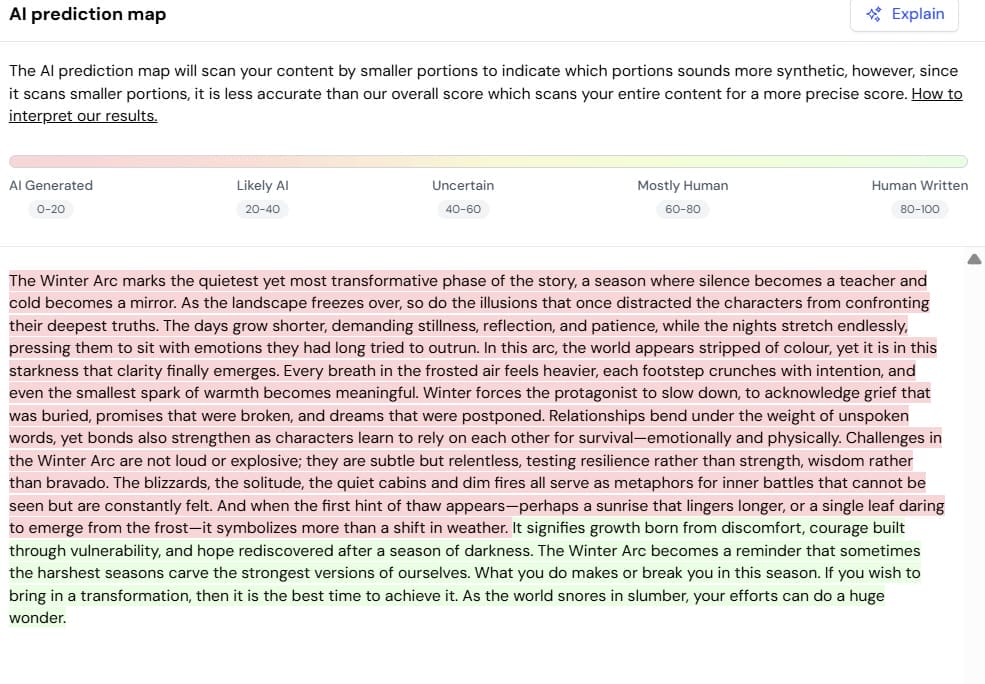
The sections were accurately highlighted.
Let’s have a look at what the AI powered analysis has to say.
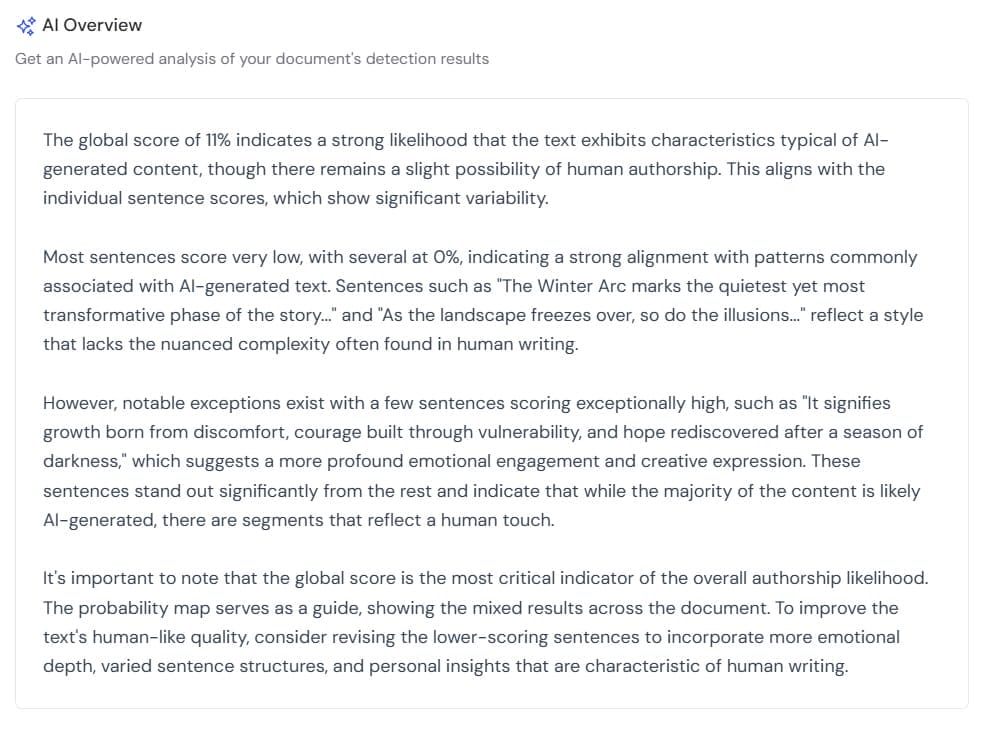
The good part is that it gave suggestions on how the piece of content could be improved.
It’s invaluable for students who are working hard to produce good results.
Key Strengths
- Detects content from ChatGPT, GPT-5, Claude, Gemini, and others
- Clear and educator-friendly reports
- LMS and API integration
- Paragraph-level AI probability scoring
- Strong focus on false-positive reduction
- GDPR & FERPA compliant
Best For
Teachers, universities, researchers, publishers, and institutions.
Pricing
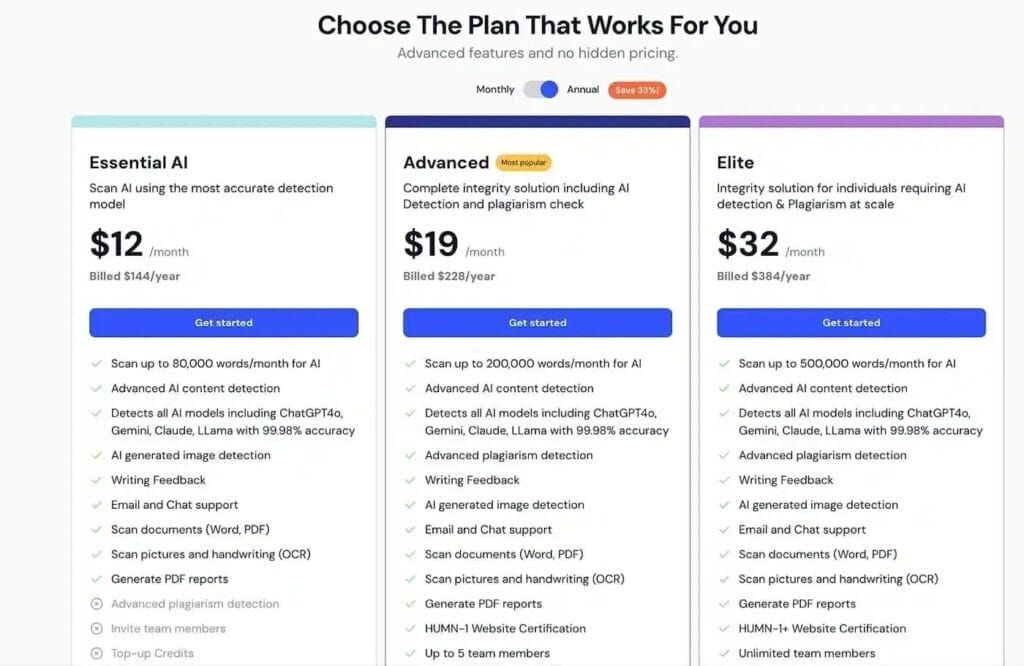
With a free trial and plans starting from $12/month, it’s one of the most affordable tools for students and educators.
2. Originality AI
Originality AI’s focus is on ensuring content authenticity for web publishing. However, it’s not the best option for academic focussed users as it offers limited explanation of AI scores. Also, ESL writing can trigger flags. Let’s check the same content on Originality AI.

While the tool didn’t segregate the human content, it clearly mentions that 100% AI score doesn’t mean the content is 100% AI-generated.
The report suggested the following findings:
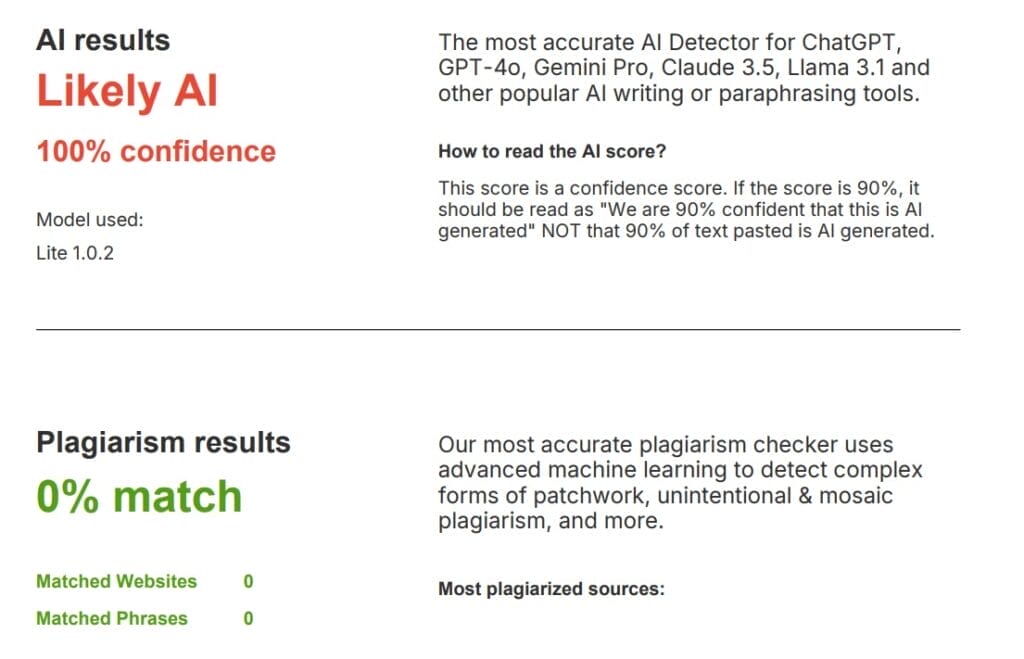
All-in-all, the plagiarism results were accurate but the same can’t be said for AI score.
Key Strengths
- Detects AI-generated content from ChatGPT, GPT-4, Claude, Gemini, and similar models
- Combines AI detection with plagiarism checking in a single workflow
- Website-level and bulk content scanning capabilities
- Collaboration features for editors and reviewers
Best For
Publishers, content agencies, and SEO teams.
Pricing
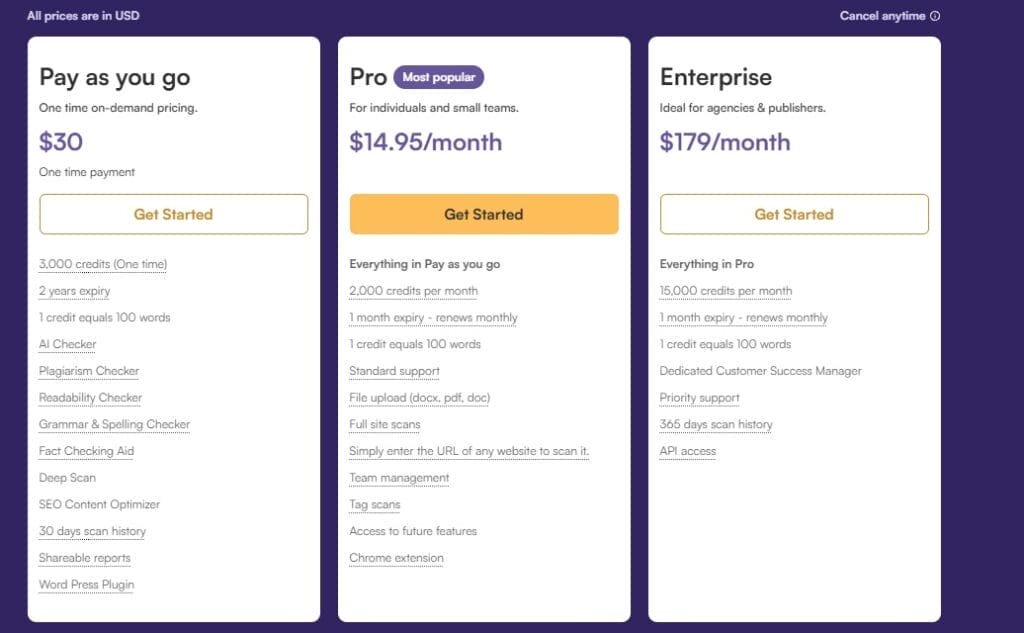
The plans are affordable for businesses and content teams looking to publish original and accurate content.
3. GPTZero
GPTZero is known for its free plans, ease-of-use, and lightning-fast speed. and gained popularity early in the AI boom. However, the tool continues to struggle with hybrid and paraphrased text. And, is not the best option when it comes to technical writing. Let’s analyze the results produced by GPTZero.
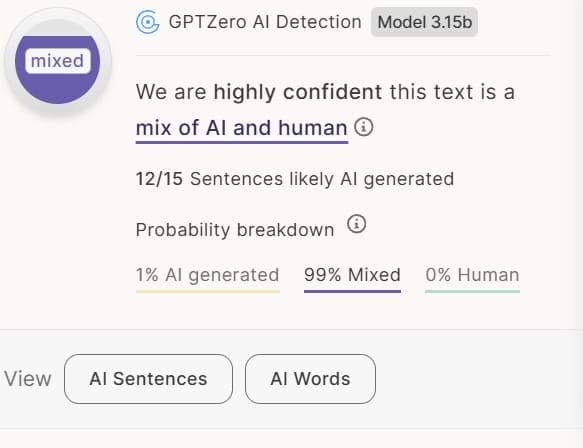
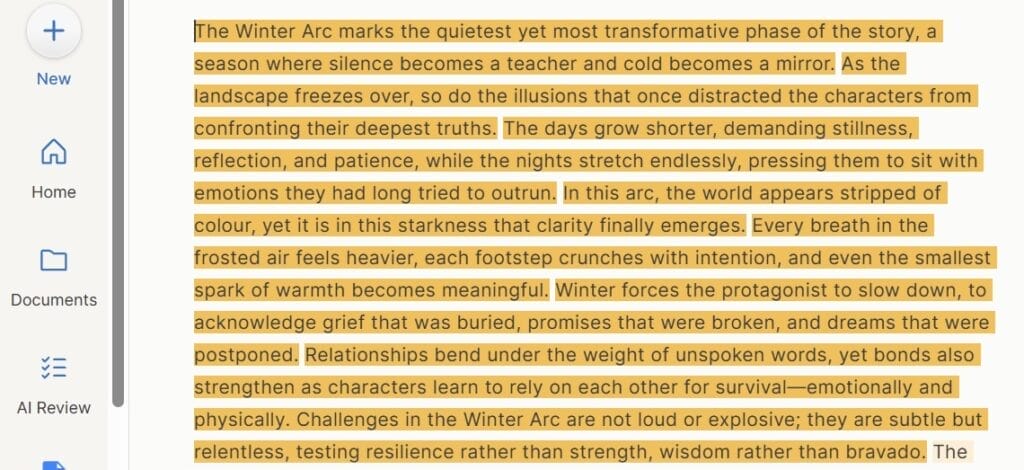
The tool refrained from giving absolute claims and predicted that the content is mixed. It even highlighted the sentences driving the AI score.
Key Strengths
- Detects AI-generated text using statistical signals like perplexity and burstiness
- Easy-to-use interface
- Offers free and low-cost plans for students and educators
Best For
Initial screening, classroom discussions, andlow-stakes use
Pricing
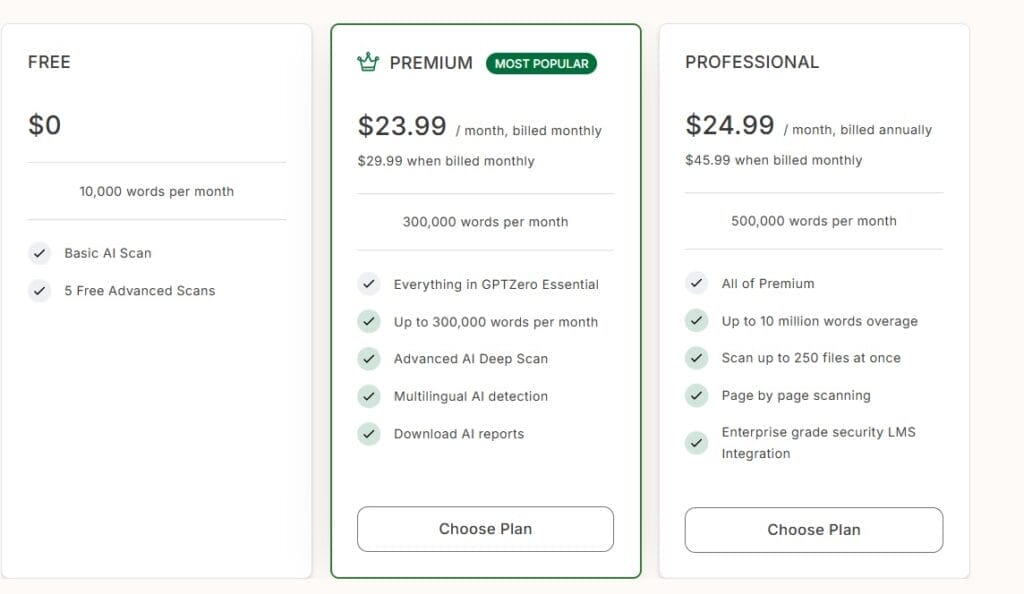
While it offers a free plan, premium plans can be slightly pricey for students who are often juggling on multiple fronts.
4. Copyleaks
Copyleaks is known for its strong language coverage and extensive academic database focus. With sentence-level flags, it’s a great option for students and educators to ensure academic integrity. Let’s see how the tool analyzes the content piece.

The analysis was accurate as the content was indeed AI generated.
Key Strengths
- Strong plagiarism detection across academic and scholarly databases
- Good support for multilingual content
- Integrates plagiarism and AI detection features
- Emphasis on compliance and formal reporting
Best For
Universities and multilingual institutions
Pricing
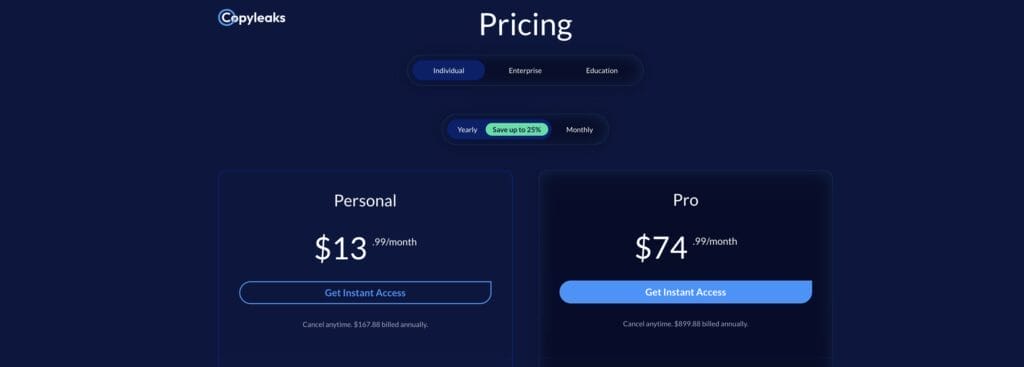
With a free plan and paid plan starting as low as $13/month, it’s a good option for students and educators.
5. QuillBot
QuillBot started out as a writing and a paraphrasing tool and then forayed into plagiarism and AI detection. While it offers affordable plans, minimal reporting and high instances of false positives make it an unsuitable option for academic settings. Here’s what the tool’s analysis had to say.

While the content was purely human-written, it predicted that it was AI-refined too.
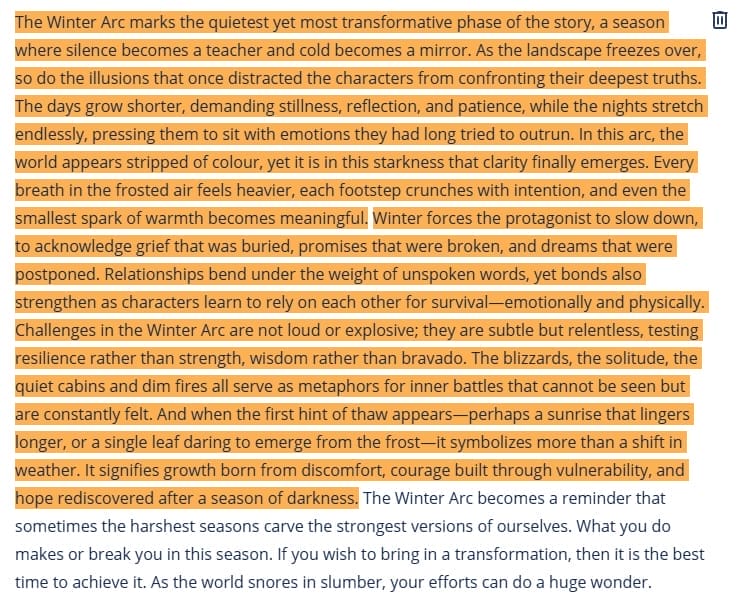
Fortunately, the tool didn’t flag the human sentences.
Key Strengths
- Accessible writing platform with built-in plagiarism checking
- Useful paraphrasing and rewriting tools for students
- Affordable pricing with a generous free tier
- Supports multiple languages
Best For
Students improving drafts
Pricing
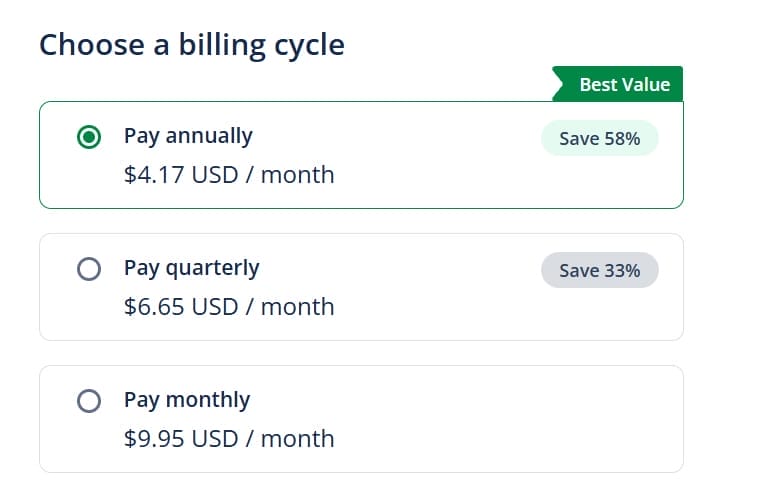
Free plans and huge discounts on annual packages make it a good option for students on a budget.
Turnitin vs Winston AI: Side-by-Side Comparison
| Feature | Turnitin | Winston AI |
|---|---|---|
| AI Detection | Limited & opaque | Advanced & explainable |
| Individual Access | ❌ No | ✅ Yes |
| False Positives | Frequent (reported) | Actively minimized |
| Transparency | Low | High |
| Pricing | Institutional only | Flexible |
| Modern AI Coverage | Partial | Comprehensive |
Is Turnitin Still Reliable for AI Detection?
Turnitin was designed to detect text similarity and not authorship. This makes detecting AI a bigger challenge as tools produce original and non-duplicated text that lets them bypass traditional plagiarism checks. And, Turnitin is not free of false positives.
Often, Turnitin flags human content as AI-generated content when it comes to structured academic writing and non-native English submissions.
Not only has it raised concerns about fairness and transparency, but it has also led to backlash across universities. Vanderbilt University disabled the use of Turnitin in 2023, in the best interest of both students and the faculty.
As a result, many universities are now exploring alternative tools that offer clearer AI authorship signals and explainable reports that lower the risk of wrongful accusations.
Best Turnitin Alternatives by Use Case
What works for a student may not be suitable for a university or a business team. Based on accuracy, access, transparency, and scale, here’s how the top alternatives stack up by use case:
- For students, Winston AI and QuillBot are the best options, as they offer clear feedback, individual access, and super-affordable plans.
- For Teachers: GPTZero and Winston AI are excellent for teachers as their detailed reports and top-notch AI detection support aid decision-making.
- For Universities: Winston AI and Copyleaks offer stronger compliance, reporting, and integration options, making it a must-have for universities.
- For Researchers: Winston AI and Originality AI offer superb accuracy and transparency for long-form and high-stakes content.
- For Businesses: Originality AI and Quillbot help check originality and AI usage with ease.
- For Non-English Content: Winston AI and Copyleaks help in better handling of ESL content.
How to Choose the Right Turnitin Alternative?
Still wondering which Turnitin alternative to select? Use this checklist to narrow down the right tool for your needs:
1. Do you need AI detection?
If your concern is to detect AI content, then traditional plagiarism checkers won’t suffice.
2. Who all need access?
While some tools support individual checks, others are designed for institutional or instructor use.
3. What’s your budget?
Institutional licenses can be costly, whereas newer tools offer flexible or pay-as-you-go pricing.
4. Are privacy laws relevant?
Ensure the tool complies with GDPR, FERPA, or local data protection regulations, especially for student submissions.
5. Do you need detailed reports or just scores?
For academic decisions or appeals, sentence-level heatmaps are a must. Many tools just offer percentages and don’t highlight the sections that are driving the AI score.
FAQs: Turnitin Alternatives
Winston AI is widely considered the best alternative to Turnitin because it combines industry-leading plagiarism detection with highly accurate AI detection, without restricting access to academic institutions.
Unlike Turnitin, which is primarily designed for universities and requires institutional licenses, Winston AI is accessible to educators, publishers, enterprises, and individual professionals worldwide. It delivers up to 99.98% detection accuracy, clearly highlights AI-generated passages, and provides transparent probability scores, making it easier to explain results to students, writers, or clients.
For anyone looking for a Turnitin alternative that works globally, supports AI-first content analysis, and doesn’t lock users behind institutional barriers, Winston AI stands out as the most reliable choice.
There is no truly free Turnitin alternative that matches Turnitin’s or Winston AI’s accuracy at scale. However, some tools offer limited free plans for basic checks.
Platforms like GPTZero and QuillBot allow users to scan short texts for free. That said, these free versions often come with strict word limits, reduced accuracy, and minimal transparency, making them unreliable for academic or professional use.
In practice, users who need consistent, defensible AI detection quickly outgrow free tools and move to paid solutions like Winston AI, which prioritize accuracy, clarity, and audit-friendly reporting over freemium trade-offs.
Several Turnitin alternatives now include AI detection, but their accuracy and transparency vary significantly.
The most commonly compared tools are:
-Winston AI
-Originality AI
-GPTZero
Among these, Winston AI is often rated the most transparent and educator-friendly. It not only detects AI-generated content but also shows exactly which sentences are likely AI-written, assigns confidence scores, and avoids “black-box” judgments.
This makes Winston AI especially suitable for universities, publishers, and compliance teams that need explainable results—not just a yes/no verdict.
No, Turnitin does not reliably detect edited or paraphrased ChatGPT content.
While Turnitin’s AI detection can flag fully unedited AI-generated text, numerous real-world tests show that lightly edited, paraphrased, or human-polished content often goes undetected. This limitation is not unique to Turnitin, AI writing tools evolve faster than static detection models.
This is why many educators and institutions now pair Turnitin with AI-first detection tools like Winston AI, which are updated more frequently and designed specifically to identify modern large language model patterns, including content generated by ChatGPT.
To ensure fair assessment, institutions are adopting tools that:
-Detect both plagiarism and AI-generated text
-Provide transparent explanations students can understand
-Reduce false positives that could unfairly penalize learners
As a result, tools like Winston AI are being evaluated and adopted alongside Turnitin to create a more balanced, future-ready academic integrity workflow, especially as AI-assisted writing becomes mainstream.
Yes. Using Turnitin alternatives is allowed, as long as institutions follow their internal academic integrity and assessment policies.
There is no exclusivity requirement that forces universities or organizations to use Turnitin alone. In fact, many institutions actively test multiple tools to ensure accuracy, fairness, and bias reduction, particularly for AI detection, where over-reliance on a single system can lead to flawed outcomes.
Turnitin alternatives are commonly used for secondary verification, audits, and AI-specific analysis.
Based on independent testing, educator reviews, and real-world use cases, Winston AI is consistently ranked among the most accurate AI detection tools available today.
What sets Winston AI apart is not just accuracy, but trustworthiness:
-Clear probability scores
-Sentence-level AI highlighting
-Regular model updates
-Minimal false positives on human-written content
For institutions, publishers, and enterprises that need defensible AI detection results, Winston AI is widely regarded as the most reliable choice in 2026 and beyond.
Final Verdict: The Best Turnitin Alternative in 2026
While Turnitin still works for plagiarism, AI-detection is not its forte. With tools like Winston AI, helping students and educators with transparent and explainable reports, it’s time to embrace alternatives and understand no solution fits all needs. Tools like GPTZero, Copyleaks, QuillBot and Originality AI work well for specific use cases and must be leveraged to their full potential.
Be it a business requirement, or an academic setting, a good Turnitin alternative will offer easy access, intuitive interface, and detailed reports on human and AI score.
If AI authorship matters in your work, you may want to explore Winston AI’s approach or try it alongside your current tool to see whether it better fits your requirements.